


Following the global pandemic, businesses have been forced to accelerate their digital transformation initiatives to accommodate a growing hybrid workforce. This has led to an increased need for strong, in-house business app development solutions that are both efficient and scalable, while also promoting collaboration and speeding up delivery. A key decision many businesses face during this process is selecting between low-code and high-code approaches for developing their own business applications. The best choice of no code low code platforms or Traditional App Development platform depends on various factors, including specific requirements, expected development timeline, employee skillsets, and budget limitations.
Let’s explore the no code low code platforms Vs Traditional app development debate in greater detail to gain a clearer understanding of these two different methodologies.
What is No Code/Low Code Platforms?
No code low code platforms enable you to create applications without requiring extensive coding knowledge. Gartner, Inc.’s recent report projects that the global market for low-code development technologies will reach $26.9 billion in 2023, marking a 19.6 percent increase from 2022.
Rather than relying on complex programming languages, low-code platforms use drag-and-drop editors for building applications and workflows. They also offer pre-built features and reusable components, allowing for faster development. This means that anyone within the organization, even those with limited technical skills, can develop applications using a no code low code platforms.
Need of No Code/Low Code Platforms
Consider a retail business that needs to quickly develop a mobile app to manage inventory across several store locations. The app should be easy to use and offer basic features such as barcode scanning, inventory updates, and alerts when stock levels are low.
By leveraging a no code low code platforms, the business can efficiently design and deploy the app. The platform’s drag-and-drop functionality simplifies the creation of a user-friendly interface, and pre-built features like barcode scanning and notifications can be easily added. Since the app doesn’t require advanced features or stringent security measures, a low-code platform is an ideal choice, enabling rapid development without requiring extensive coding skills.
Traditional App Development?
Traditional App development refers to the traditional programming approach, where experienced developers are responsible for writing code and developing solutions from scratch. This method is more reliant on coding, tightly linked to development cycles, and fully controlled by developers. The key advantage of high-code is that it enables the creation of custom business applications tailored to the specific needs of your organization.
However, high-code also leads to a significant dependence on your IT team, which can exclude citizen developers and non-technical business users. Without involving the business users who will actually be using the application, it can be difficult to create solutions that fully address the requirements of various teams and departments. Additionally, relying on IT for both development and maintenance can pull skilled developers away from more critical work within the organization.
A Brief Comparison of Low-Code and Traditional App Development
Here’s a quick comparison to highlight their main differences between no code low code platforms and Traditional App development platforms:
| Aspect | Low Code | Traditional App Development |
|---|---|---|
| Level of Coding Expertise Needed | Minimal coding skills. Suitable for users with diverse technical backgrounds. | Extensive. Necessitates a strong proficiency in programming languages. |
| Flexibility | Limited. Might not be ideal for highly intricate or tailored applications. | High. Capable of managing complex and extensively customized applications. |
| Development Speed | Quick. Facilitates swift prototyping and application deployment. | Gradual. The process of writing, testing, and debugging code can take considerable time. |
| Collaboration | Strong. Promotes collaboration among business users, developers, and IT professionals. | Restricted. Typically demands specialized expertise, which can hinder collaboration. |
| Maintenance and Updates | Easier. Modifications can be implemented rapidly through the visual interface. | More challenging. Necessitates coding expertise and can be time-intensive. |
| Vendor Dependency | Significant. Transferring an application between platforms can be difficult. | Minimal. Code can be transferred between various systems with greater ease. |
Disadvantages of Traditional App Development
When considering high-code development, it’s important to be aware of certain drawbacks that can impact the overall development process. Let’s explore some of the key challenges associated with high-code approaches:
- Necessitates advanced programming expertise: High-code development requires significant knowledge of coding languages, which can restrict the number of people involved in the development process.
- Lengthy process: Building software from the ground up with Traditional App Development can be time-intensive, as it involves extensive coding, testing, and debugging.
- Complex maintenance and updates: Maintaining and updating high-code software often demands more time and effort due to the intricate nature of the codebase.
No Code/Low Code Platforms Disadvantages
While no code low code platforms offer many advantages, they also come with certain limitations that can affect their overall efficiency and suitability for complex projects. Here are some key disadvantages of using no code low code platforms development:
- Limited flexibility: Low-code platforms are great for building standard applications, but they may fall short when it comes to offering the flexibility required for highly specialized or complex apps.
- Vendor reliance: Because low-code platforms supply the development infrastructure, there is a risk of vendor lock-in. Transferring an application from one low-code platform to another can be difficult.
- Performance limitations: Applications developed using low-code platforms may occasionally encounter performance challenges, especially when managing large datasets or handling complex processes.
How Low Code Simplify App Development?
Low-code platforms are transforming app development by fostering a collaborative space that simplifies the process of building applications. With visual development tools, such as drag-and-drop functionality, these platforms enable users to create software with little coding knowledge. This makes app creation accessible to both non-technical business users and experienced developers. The low-code factory model encourages collaboration, innovation, and participation from all stakeholders throughout the development process, ensuring quality and consistency at every stage.
Low Code vs High Code: What’s Right for You?
One of the main differences in low code vs traditional development is the level of customization each approach allows. High-code applications might initially seem ideal for developing legacy systems. However, in today’s ever-changing tech landscape, building hard-coded, monolithic applications from the ground up can become extremely costly. The need to scale and upgrade such systems every few years adds to the challenge and expense.
When deciding between low code and Traditional app development, the solution is clear. If you need a flexible business application development platform that allows for customization, quick delivery, reusability, and affordability, low code is often the better choice.
Key Features of No Code Low Code Platforms
Low-code platforms provide various functionalities that make application development faster and easier. Some notable features are:
- Visual Development: An intuitive drag-and-drop interface for creating applications visually.
- Reusable Components: Pre-built templates and modules for enhanced development efficiency.
- Integration Capabilities: Effortless integration with third-party services and APIs.
- Workflow Automation: Simplified handling of intricate business processes.
- Security Features: Integrated safeguards to ensure the protection of applications and data.
- Scalability: Seamless growth capability to handle increasing user demands and evolving requirements.
- Cross-Platform Compatibility: Compatibility across various devices and operating systems.
- Deployment Options: Versatile deployment options, including both on-premises and cloud-based environments.
Choosing Between Low Code Platforms vs High Code Development?
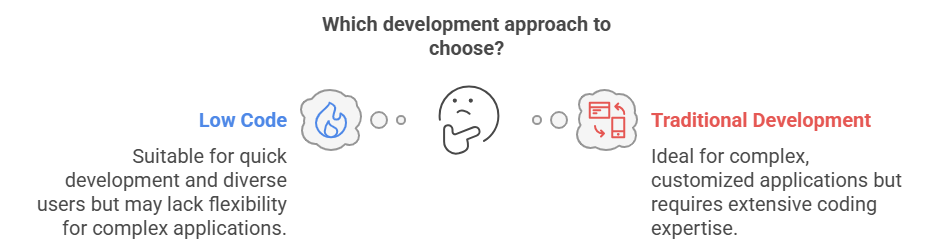
Security and scalability are two important considerations in the low code vs traditional development decision-making process. Connect with one of our experienced advisors to discuss your project, and we’ll assist you in selecting the ideal app development strategy tailored to your needs. Whether you’re leaning towards the efficiency of low-code or the flexibility of traditional development, we can provide the insights you need. Contact us today for FREE consultation to determine the best path forward for your project’s success.